
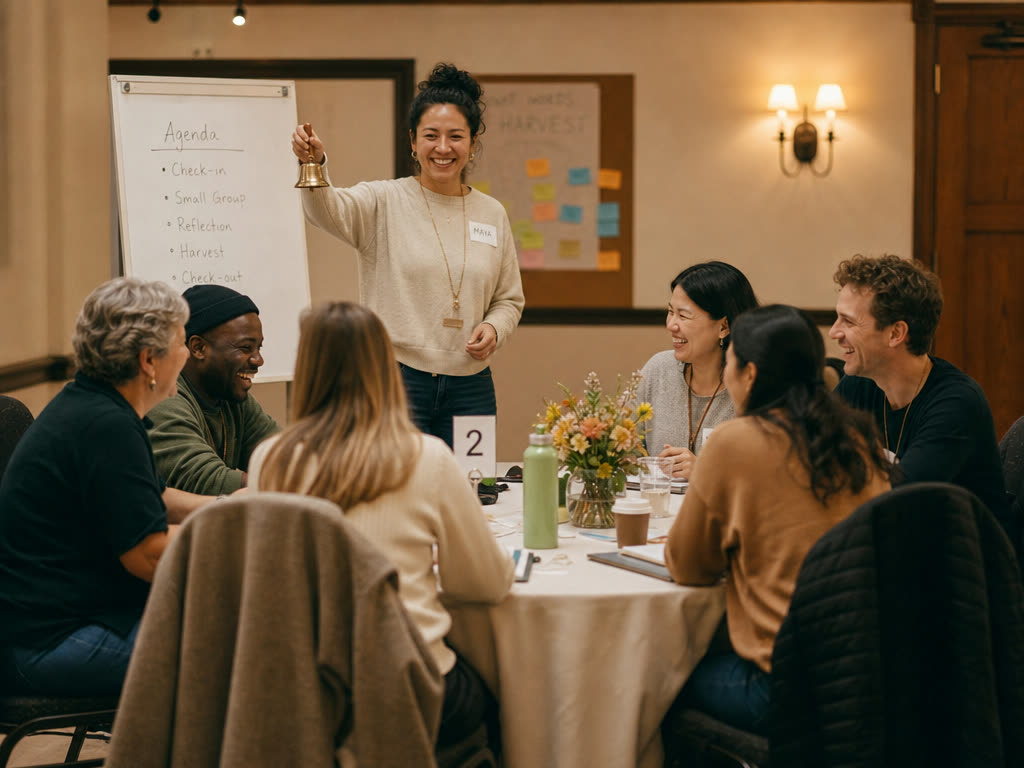
The best conversation at your event ran twenty minutes over and nobody wanted to end it.
You can feel the difference from across the room. One group is watching the clock. Another has forgotten there is a clock. Same event, same attendees, same forty minutes on the schedule.
The difference is not chemistry. It is four variables that were set before anyone spoke.
Two Rooms, One Schedule
§ 01 · DiagnosisOrganizers tend to treat conversation quality as luck. Some groups click, some do not, and there is nothing to be done. That belief is expensive, because the groups that click usually share the same setup.
The room that stalls has a recognizable profile:
- Too many people for everyone to have a turn
- A prompt broad enough that answering it feels like volunteering for a speech
- No shared reason for these particular people to be together
- Enough time that the conversation dies before the session ends
Every one of those was decided by the organizer, not by the attendees.
Why Some Conversations Hold and Others Drain
§ 02 · The CauseAn absorbing conversation looks a lot like flow: the task is clear, the challenge matches the participants, and feedback is immediate. Conversations lose people when any of those three break, and the usual break is the first one. Nobody is sure what they are supposed to be talking about.
Four variables decide it, and they interact:
- Group size
Three to four people means everyone speaks. Ten means most people watch, and the ones watching disengage first.
- Shared reason
Groups formed around a common problem skip the throat-clearing entirely.
- Prompt specificity
A concrete question gives everyone an entry point. An abstract one gives it only to the most confident person present.
- Round length
Ending while the energy is high leaves people wanting more. Ending after it drains teaches them the format does not work.
Designing a Conversation People Stay In
§ 03 · The PlaybookThese choices cost nothing to make and change the room completely:
- Cap groups at four
Especially online. Four people is a conversation, eight is a meeting with an accidental chair.
- Group on intent
Put people together because of what they are trying to solve, not because of where they were sitting.
- Write the opening question yourself
Something answerable in one sentence from personal experience. Test it by answering it out loud first.
- End early on purpose
Eight to twelve minutes per round. Cut it while people are still talking.
- Rotate
Multiple short rounds beat one long one. Everyone meets more people, and a weak pairing costs one round.
- Make the follow-on obvious
If a group wants to keep talking, give them somewhere to go before you move everyone on.
The last point matters more than it sounds. A conversation nobody wanted to leave should not be forcibly ended with no way to continue it.
This piece is about the conversation itself. For how the same decisions play out specifically in breakout sessions, including rotation and room sizing, see the difference between awkward breakout rooms and great conversations.
"A conversation people do not want to leave is not a happy accident. It is four decisions, all of them made before the room opened."
Connection by Design, Vol. 01Where the Variables Get Set
§ 05 · HoogahSetting four variables for one group is easy. Setting them for sixty groups, then rebuilding when a third of the room does something unexpected, is where it falls apart by hand.
That is where Hoogah fits. Attendees answer a short set of questions at signup, Hoogah builds right-sized groups around shared intent, carries the prompt into the room, and moves everyone between rounds in one click. It runs the same way in person and in virtual breakout rooms. The flow is on how it works, and the formats are on use cases.
What changes:
- Groups start talking within seconds because the shared reason is visible
- Quieter attendees speak, since four people leaves nowhere to hide and no need to compete
- Rounds end while the conversation is still alive
- You can see which rounds worked instead of guessing from the noise level
Nobody remembers a session that ran to time. They remember the one they did not want to leave.
Frequently Asked Questions
§ 06 · FAQWhat makes a conversation engaging at an event?
A small group, a shared reason for being together, a specific opening question, and a round that ends before the energy does. Those four account for most of the difference between a great table and a flat one.
How many people should be in a group?
Three or four for real conversation, up to six if the prompt is strong. Beyond that, participation drops and the quietest people stop contributing entirely.
What makes a good conversation prompt?
Something answerable from direct experience in one sentence. "What changed in your process this year?" works. "What is the future of the industry?" produces silence and then one monologue.
How long should each round last?
Eight to twelve minutes. Short enough to keep energy high, long enough to get past introductions, and short enough that a poor pairing is not a lost session.
Does this work the same for virtual breakout rooms?
The same variables apply and they matter more. Silence is harder to recover from online, so smaller groups and sharper prompts do more work in a virtual room than in a physical one.
- Flow, on the conditions under which people lose track of time in an activity