

Great breakout sessions are not created by chance.
Everyone has sat in the bad version: twelve people, one person talking, ten minutes of polite silence, then relief when the timer ends. Everyone has also been in the good version, where the conversation ran past the allotted time and people swapped details afterwards.
The gap between those two rooms is not the topic and it is not the attendees. It is four decisions made before the session started.
Twelve People, One Talker, and a Lot of Silence
§ 01 · DiagnosisBreakouts fail in a predictable way. The group is too big, nobody knows why they were put together, the prompt is vague enough that only the most confident person answers it, and the timer runs long enough for the energy to drain out of the room.
What makes this frustrating is that the same attendees, in a better-designed room, would have talked for an hour. The failure is structural, not personal. Watch for these signs:
- One person answering every prompt while the rest nod
- Groups that spend the first five minutes deciding who goes first
- A discussion question so broad that nobody knows where to start
- Attendees checking phones because the session has nothing to do with why they came
Nobody blames the format. They blame the event.

Why Breakout Sessions Go Quiet Before Anyone Speaks
§ 02 · The CauseGroup size is the single most underrated variable in the room. As a group grows, individual contribution drops, a well-documented effect known as social loafing. In a group of four, silence is uncomfortable and everyone speaks. In a group of twelve, silence is somebody else's problem.
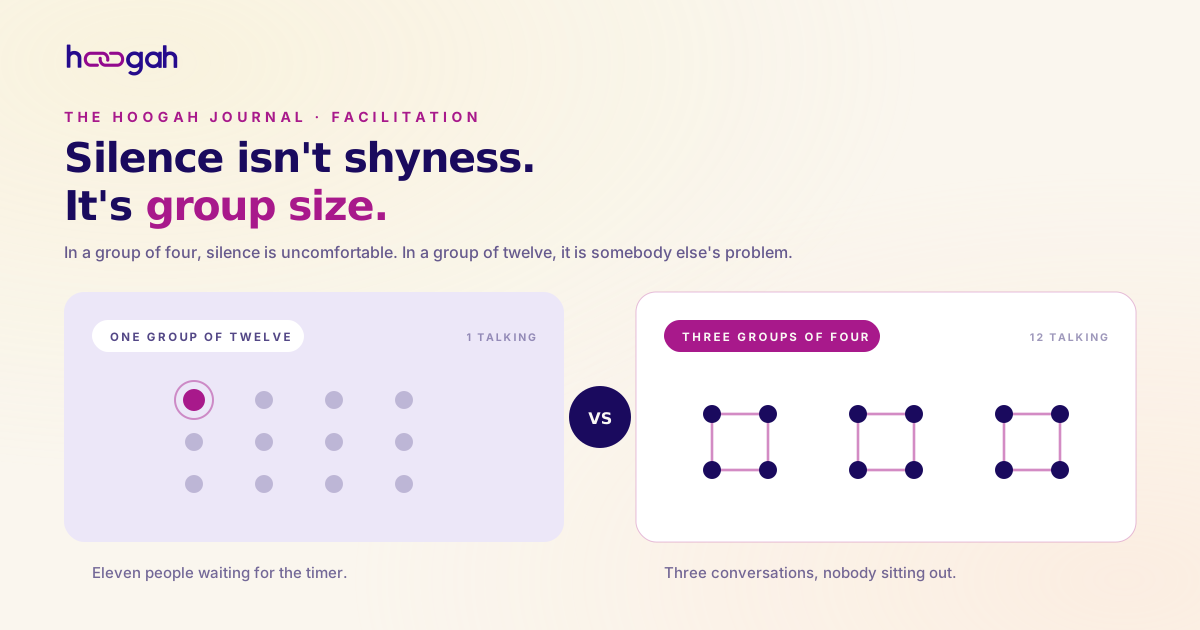
Size interacts with everything else you decide:
- Two to three people
Creates real conversation but needs stronger prompts.
- Four to six
The reliable middle. Enough perspectives without letting anyone disappear.
- Eight or more
Turns into a panel with an accidental host.
- The larger the group
The more specific the prompt has to be.
The Breakout Room Features That Actually Matter
§ 03 · The PlaybookStrong breakouts come from a short list of design choices, applied consistently:
- Participant matching
Group people by what they came to discuss, not alphabetically. Shared context removes the first five minutes of throat-clearing.
- A specific prompt
"Discuss the future of the industry" produces silence. "What changed in your process this year and what did you do about it?" produces ten minutes immediately.
- Right-sized groups
Default to four to six. Go smaller when you need deeper conversation, never larger for the sake of covering the room.
- Tight timing
Short rounds with a visible clock beat long sessions. End while the conversation is still alive, not after it has died.
- Rotation
Multiple short rounds with different people beat one long session. Every attendee meets more of the room, and a bad pairing costs eight minutes instead of forty.
Get those five right and the facilitation problem mostly disappears.
"An awkward breakout is not bad luck. It is an unmade decision about who should be in the room, and what they should discuss."
Connection by Design, Vol. 01Where the Setup Actually Happens
§ 05 · HoogahThe reason most organizers do not run breakouts this way is that matching people by intent, sizing groups correctly, and rotating them cleanly is difficult to do by hand with two hundred attendees and a schedule that changes.
That is where Hoogah fits. Attendees answer a short set of questions at signup, Hoogah builds the groups from those answers, and rebuilds them around who actually turned up. You move everyone between rounds in one click and see engagement as it happens. Walk through the full flow on how it works or see the formats it runs in use cases.
What changes in the room:
- Groups start talking within seconds because the shared reason for being there is obvious
- Nobody sits out, because the group is small enough that participation is expected
- Quieter attendees contribute, since four people is a conversation rather than a crowd
- You get engagement data per round instead of guessing which groups worked
An awkward breakout is not bad luck. It is an unmade decision about who should be in the room, what they should discuss, and about what.
The same four variables apply to any conversation you are designing, not only breakouts. That version is in how to design conversations people do not want to leave.
Frequently Asked Questions
§ 06 · FAQWhat is the ideal breakout room size?
Four to six people for most discussion formats. That is large enough to bring different perspectives and small enough that silence feels awkward, which is what keeps everyone contributing.
How long should a breakout session run?
Shorter than you think, usually eight to fifteen minutes per round. Multiple short rounds with rotation outperform one long session, because energy stays high and a poor pairing costs minutes rather than the whole session.
Do conversation prompts really make a difference?
They make most of the difference. A vague prompt puts the burden on the group, while a specific, concrete question gives everyone an obvious entry point and gets the room talking immediately.
How do I group people if I do not know them?
Ask at signup. A short set of questions about what someone wants to achieve gives you far better grouping logic than job title, seniority, or company size, all of which describe people rather than their intent.
Does this work for virtual breakouts too?
Yes, and the design choices matter more online. Silence is harder to recover from in virtual groups, so smaller groups, sharper prompts, and tighter rounds are essential to keeping virtual breakout sessions from stalling.
- Social loafing, on why individual contribution drops as group size grows