

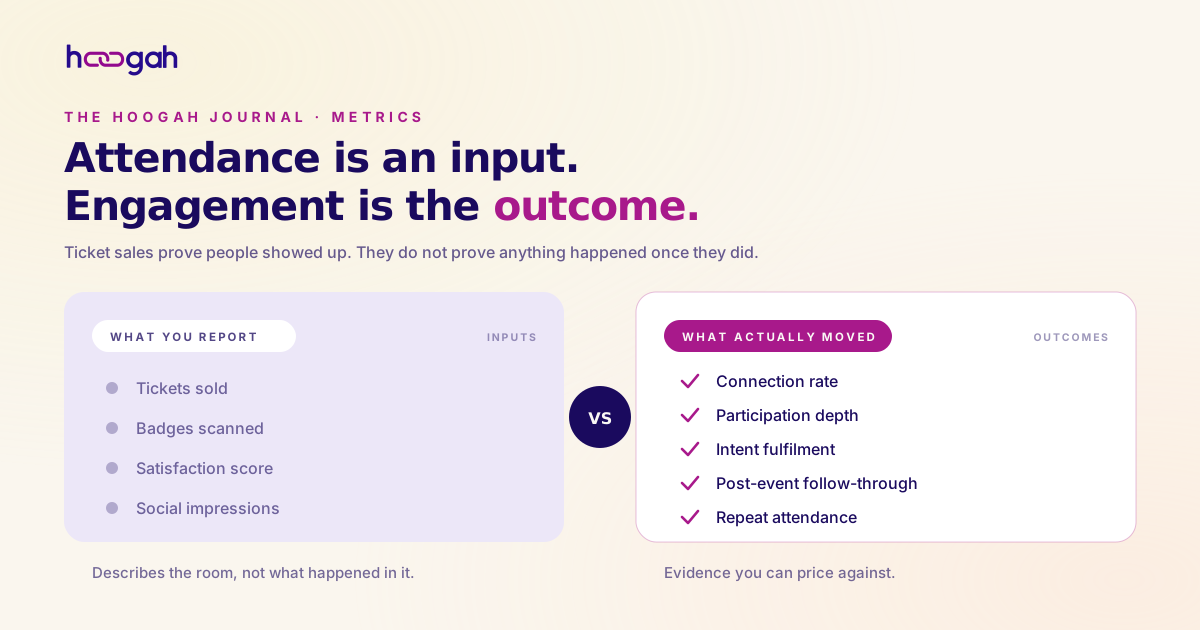
Ticket sales prove people showed up. They do not prove anything happened once they did.
Most post-event reports lead with attendance, satisfaction scores, and social impressions, then quietly avoid the question everyone is actually asking: did this room create any value?
Attendance is an input. Engagement is the outcome. If your reporting only covers the first, you are measuring the cost of the event and not its return.
Your Report Looked Great. Your Sponsor Still Hesitated.
§ 01 · DiagnosisEvery organizer has been in this conversation. The numbers were strong. Registrations up, no-show rate down, satisfaction at 4.6 out of 5. Then the sponsor asks what they got for the money, and the honest answer is a footfall estimate and a photo of a busy booth.
The problem is not that these numbers are false. It is that they describe a room, not what happened inside it. Here is what a surface-level report usually hides:
- High attendance with most attendees speaking to nobody new
- Strong satisfaction scores from people who will not return
- Booth traffic counted as leads, with no record of who actually talked
- Session capacity treated as interest, when half the room was there for the aircon
Numbers that only go up when more people buy tickets will never tell you whether the event was worth attending.
Event Engagement Metrics Tell You What Attendance Cannot
§ 02 · The CauseSatisfaction is the metric organizers lean on hardest, and it is the least predictive one they have. Even Net Promoter Score, the standard shortcut for measuring loyalty across industries, is widely criticised for weak correlation with actual repeat behaviour. People rate an experience on how it felt in the moment. They return based on what it left them with.
Attendee engagement is closer to the truth because it records behaviour instead of opinion:
- A scan at the door
Tells you someone arrived, nothing more.
- A completed introduction
Tells you two people had a reason to talk.
- A follow-up after the event
Tells you the connection had value.
- A returning attendee
Tells you the whole thing worked.

The Event KPIs Worth Tracking
§ 03 · The PlaybookYou do not need forty metrics. You need a handful that describe whether people connected, participated, and got what they came for.
- Connection rate
The share of attendees who made at least one relevant new contact, not the number of badges scanned.
- Participation depth
How many attendees did something active, whether that is a question asked, a session joined, or a one-to-one taken.
- Intent fulfilment
The percentage of attendees who got what they said they came for, measured against what they told you at signup.
- Post-event follow-through
Contacts exchanged that turned into a message, a meeting, or a deal in the weeks after.
- Repeat attendance
The cleanest signal there is, because nobody rebooks an event that wasted their time.
Track these across editions and your reporting stops being a summary of the day. It becomes evidence you can price against.
"Attendance tells you how many people you sold to. Engagement tells you whether you should expect them back."
Connection by Design, Vol. 01Where That Data Actually Comes From
§ 05 · HoogahMost organizers do not skip these metrics because they disagree with them. They skip them because there has been no practical way to capture what happens between people in a crowded room.
That is where Hoogah fits. Attendees answer a short set of matching questions at signup, so you know their intent before the doors open. Hoogah pairs them accordingly, records the introductions made, and tracks engagement through the day. Afterwards you get a picture of who connected and how much of the room actually participated. You can see the full flow on how it works and the event types it supports in use cases.
What that changes in practice:
- Sponsors get connection data instead of a footfall estimate
- Leadership gets a number that maps to business outcomes, not vibes
- You can spot a quiet room and fix it during the event, not after
- Year-on-year comparisons finally measure the same thing
Attendance tells you how many people you sold to. Engagement tells you whether you should expect them back.
Frequently Asked Questions
§ 06 · FAQWhat are event engagement metrics?
They are measures of what attendees actually did, rather than how many turned up. Connection rate, participation depth, intent fulfilment, and post-event follow-through all describe behaviour inside the event, which is what determines whether people found it worthwhile.
Isn't attendance still an important event KPI?
It is, but it is a top-of-funnel number. Attendance tells you your marketing worked and says nothing about whether the event delivered, which is why it should sit alongside engagement data rather than standing in for it.
Why are satisfaction scores unreliable?
Because satisfaction measures mood and retention measures value. Attendees routinely rate an event highly, enjoy the day, and never return, so a strong score with weak rebooking usually means the content landed but nothing lasting came out of the room.
How do I measure attendee engagement without surveying everyone?
Capture intent at signup and record behaviour during the event. Introductions made, sessions joined, and contacts exchanged are all observable, so you get real data without relying on a feedback form only a fraction of attendees complete.
What should I report to sponsors?
Show them who their audience actually met and how many relevant conversations happened at their stand or through matched introductions. Sponsors renew on pipeline, not on impressions, so connection data is far more persuasive than attendance totals.
- Net Promoter Score, on the weak correlation between satisfaction scores and repeat behaviour